
PayShap Explained: Instant Payments to Any Bank Account — Not Just a Phone Number
Ask most South Africans what PayShap is and you'll hear the same thing: "It's that thing where you send money to someone's cellphone number." That's true — but it's only half the story, and the half everyone misses is the more useful one. PayShap's real superpower isn't the phone number. It's speed: money moves in seconds, any time of day, any day of the year — and it works whether you send to a phone number or to a normal bank account.
What PayShap Actually Is
PayShap is South Africa's real-time payment system, built by BankservAfrica and the country's banks. Think of it as a shared express lane that connects the major banks so money can move between them instantly. It's supported across the big names — Absa, Capitec, FNB, Nedbank, Standard Bank, TymeBank, African Bank, Discovery, Investec and more — so most people with a bank account already have access; you just switch it on in your banking app.
The Radical Advantage: It's Instant
This is the part that changes how you live with money. A PayShap payment clears in under ten seconds, 24/7 — weekends, public holidays, midnight on a Tuesday, it doesn't matter. Both sides get an instant notification.
Compare that to what most people are used to:
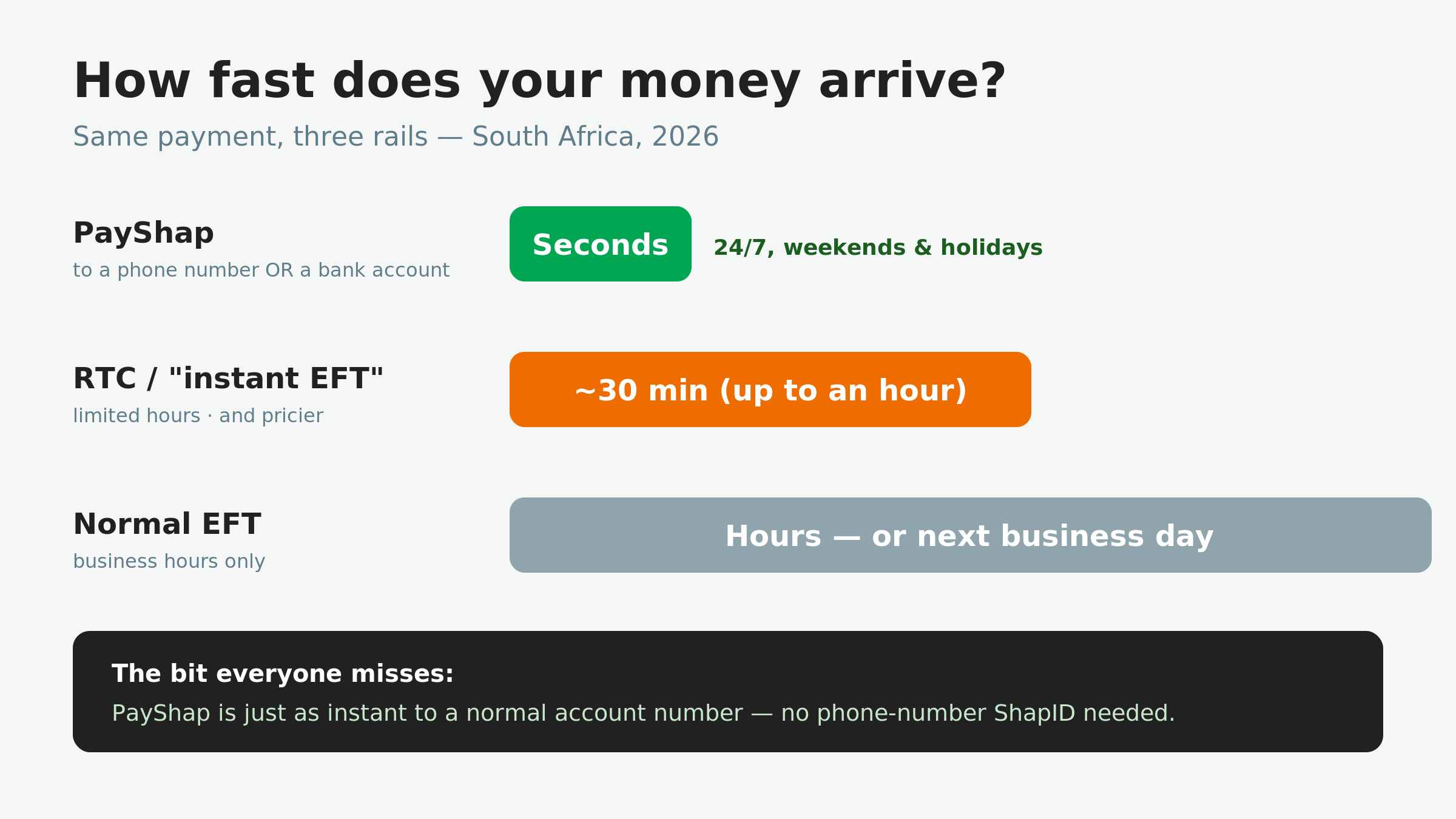
- PayShap — seconds, any time, any day.
- RTC ("instant EFT") — same-day, but not actually instant; in practice it often takes around 30 minutes, sometimes up to an hour, and it costs more.
- A normal EFT — hours at best, and frequently only the next business day if it's a weekend or after hours.
If you've ever sat watching your phone waiting for an "instant" EFT to land before someone would release your goods, you already understand why this matters. PayShap removes the wait entirely.
The Myth: "PayShap Is Only for Phone Numbers"
Here's the misconception worth clearing up, because it stops people using PayShap properly.
PayShap has two ways to send money, and both are equally instant:
- Pay to a ShapID — a "proxy" linked to someone's account, usually their cellphone number. Handy when you don't have their banking details: you just need their number.
- Pay to a normal bank account — the recipient's ordinary account number and bank. No ShapID required at all.
That second option is the one people overlook. You do not need the other person to have set up a ShapID. If you have their account number, you can send via PayShap and the money still lands in seconds — far faster than the RTC or EFT you'd normally reach for to pay that same account. So the next time you're about to do a slow, pricey "instant EFT" to an account number, check for the PayShap option instead: same destination, a fraction of the time.
A Few Things Worth Knowing
- Limits: PayShap handles single payments up to around R50,000, though each bank sets its own limit — check yours in the app.
- Fees: these vary by bank, and small payments are often cheap or free; paying to a ShapID is usually cheaper than paying to an account number, so it's worth comparing both in your app.
- It can't be reversed: because it's instant, double-check the number or account before you confirm. If anyone asks for your PIN or OTP "to receive" a PayShap, it's a scam — see our guide on protecting yourself from digital payment scams.
Where SOLmate Fits In
Let's be straight: SOLmate is a digital wallet, not one of the banks on the PayShap network, so you don't send a PayShap from SOLmate. What SOLmate does is sit alongside it. Transfers between SOLmate users are free and instant, your everyday spending — tap-to-pay, airtime, electricity — is low-cost or free, and you can receive money into your SOLmate account by EFT for free. The smart setup for most people is simple: use your bank's PayShap for instant transfers to anyone, and use SOLmate to keep your everyday running costs down. (And if a traditional bank has ever turned you away for not having a green ID, SOLmate opens an account with just a passport or asylum permit — see how it works.)
The Bottom Line
PayShap isn't just "money by cellphone number." It's instant money — in seconds, around the clock — and it works just as well sending to a normal bank account as to a phone. Once you know that, the slow, expensive "instant EFT" stops making sense for most everyday payments.
Want the rest of your money to move as fast and cost as little? See what SOLmate offers — free transfers between users, free airtime and electricity top-ups, and a Mastercard debit card, from R10/month.
Frequently Asked Questions
Can PayShap pay to a normal bank account, not just a phone number?
Yes. PayShap has two methods: pay to a ShapID (a proxy such as a cellphone number) or pay directly to a normal account number and bank. Both clear in seconds — you do not need the recipient to have a ShapID.
Is PayShap faster than an instant EFT or RTC?
Yes. PayShap clears in under ten seconds, 24/7. RTC (often called "instant EFT") is same-day but not truly instant — in practice it commonly takes around 30 minutes, sometimes up to an hour — and it usually costs more.
Is PayShap free?
Fees are set by each bank. Small payments are often cheap or free, paying to a ShapID is usually cheaper than paying to an account number, and limits run up to about R50,000 per transaction depending on your bank. Check your banking app for your exact fees and limits.
New to digital payments? Read the hidden cost of cash in South Africa.
Sources: PayShap (BankservAfrica)